
Sport & Performance Psychology
Sport and performance psychology is the science and practice of optimizing how athletes think, feel, and perform — recognizing that excellence is never achieved in isolation. Athletes exist within teams, coaching relationships, organizations, and broader systems that profoundly shape their development, motivation, and wellbeing. This work takes a holistic, systems-informed approach: supporting individual mental skills like motivation, confidence, and resilience, while also strengthening the relational and organizational environments that either enable or undermine performance. When athletes, coaches, and the cultures around them are aligned, the conditions for sustained excellence — and genuine wellbeing — become possible.
What is Sports & Performance Psychology?
Performance psychology is the study and application of psychological principles to help people consistently perform at the upper range of their capabilities — and to find more enjoyment in the process of doing so (Portenga, Aoyagi, & Cohen, 2017).
Sport psychology is a subdomain of this field, applying those same principles specifically within athletic contexts. Beyond sport, performance psychology extends to performing artists, business leaders, medical professionals, and those working in high-risk occupations — any environment where the mental side of performing under pressure matters.
Put simply, sport and performance psychology is about helping people learn how to perform better, more consistently, in pursuits where excellence counts. The goal isn't just peak performance in isolated moments — it's helping people become the best they are capable of being across their performance endeavors (Peterson, Brown, McCann, & Murphy, 2012).

Who Can Benefit from Sports & Performance Psychology Support?
Whether you are an athlete battling performance anxiety before a big competition, a performer struggling to trust yourself under pressure, or a coach searching for ways to better support and connect with the people you lead — you are not alone, and these experiences are far more common than most people realize.
Sport and performance psychology draws on the science of human behavior to help athletes, performers, and coaches build the mental and relational skills that make a real difference — focus, confidence, resilience, motivation, and the ability to perform when it matters most. This work recognizes that no one performs in isolation: athletes grow and thrive within teams, coaching relationships, and organizational cultures that shape their development, sense of belonging, and wellbeing. By taking a warm, systems-informed approach — one that works with the people and environments around performance, not just the performer — the goal is to create conditions where excellence and genuine wellbeing are not competing priorities, but deeply connected ones.
Sport
Athletes, Coaches,
& Teams
Performing Arts
Musicians, Dancers,
& Actors
Business
Leadership & High
Performance
Medicine
Surgeons &
First Responders
High Risk
Military &
Emergency Services
How is Sports & Performance Psychology helpful?
Sport and performance psychology support is for anyone who performs under pressure — regardless of level, background, or context.
From recreational athletes finding their footing to elite competitors performing on the world stage, from performing artists and musicians to tactical athletes such as first responders, military personnel, and law enforcement — this work is built around the understanding that the mental demands of performance are universal, even when the arena looks different.
Coaches and support staff are equally welcome, as are teams and organizations looking to strengthen their culture, communication, and collective performance. Whether you are an individual seeking personal growth, a leader wanting to bring out the best in others, or a team striving to perform and connect at a higher level, these services meet you where you are and work with the full picture of who you are and the environment you perform in.
Over the last decade, Dr. Ward has trained and specialized in a broad range of activities including the identification, development, and execution of the mental and emotional knowledge and skills required for excellence in performance domains. This includes the understanding, assessment, and managing of the cognitive, emotional, behavioral, and psychophysiological inhibitors of consistent, excellent performance; and the improvement of athletic contexts to facilitate more efficient development, consistent execution, and positive experiences in performers.
Dr. Ward is interested in understanding and optimizing sport and performance from a psychological and relational perspective. Part of his focus is to uncover and apply scientifically proven approaches and skills to educate performers and assist them in finding effective and efficient ways to maximize their experiences and performances in their particular contexts. This also involves understanding and strengthening the relationships, environment, and systems the performer exists in.
His work generally involves engaging with individuals and teams (including coaches) in a consulting or counseling process to help them enhance and maintain mental performance and mental health. Through a variety of educational means and strategies, he helps performers learn how to increase the proficiency with which they use cognitive processes and self-regulation skills to successfully manage their thoughts, emotions, and behaviors and reach their performance and well-being goals in demanding and changing environments.
Within his applied sport and performance psychology work, Dr. Ward’s focus is on facilitating holistic and comprehensive performance development for individual athletes, teams, and sport organizations. What sets this work apart is Dr. Ward’s commitment to serving the whole person — not just the athlete or performer you show up as, but the human being beneath that role. As a licensed mental health counselor, Dr. Ward is uniquely positioned to recognize when performance struggles are connected to deeper concerns like anxiety, depression, or relationship difficulties— and to address both in one place. Many athletes benefit from a combination of mental health counseling and mental performance skills work, and Dr. Ward can integrate the two, offering a level of care that meets you wherever you are and supports all of who you are.
Approach & Expertise:
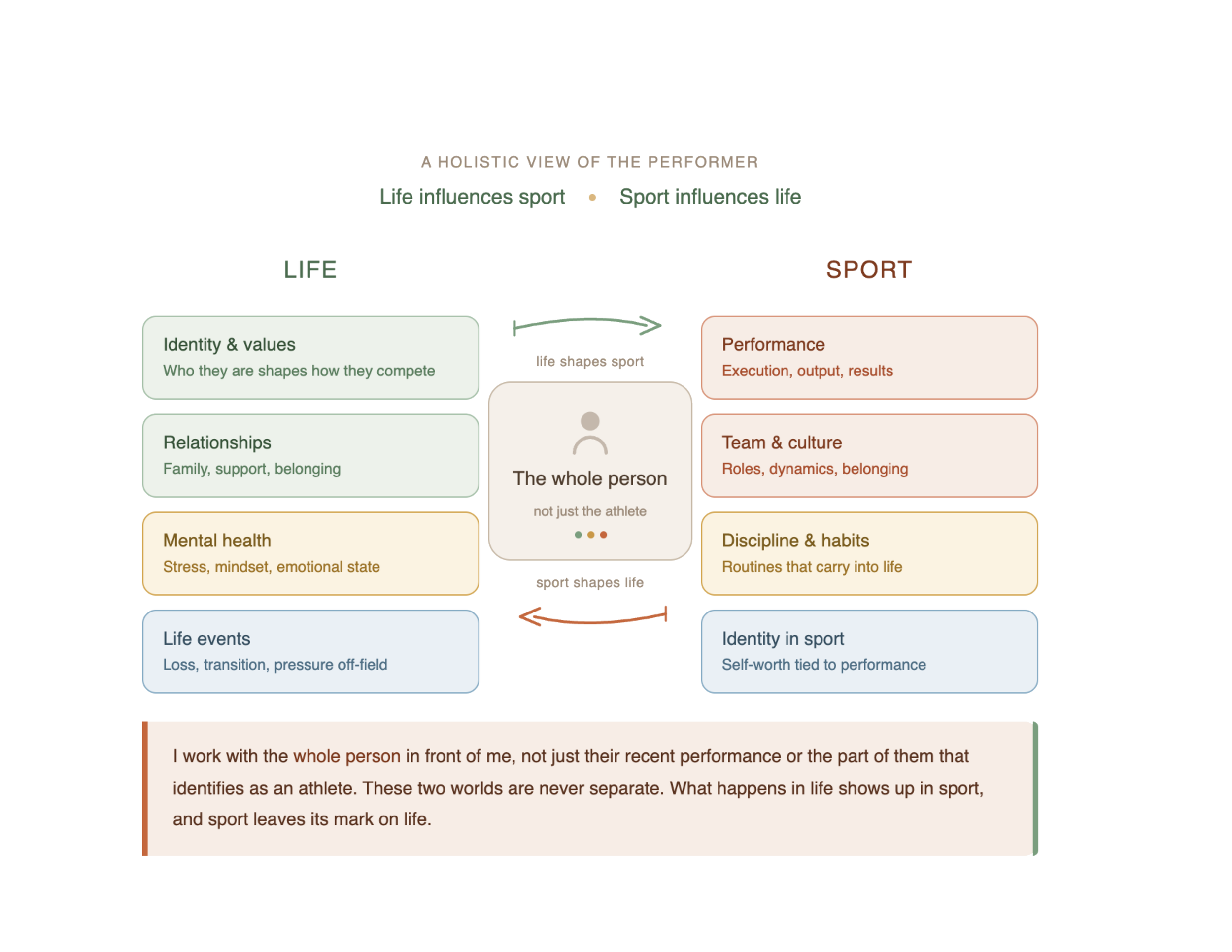
Life Influences Sport - Sport Influences Life
Mental Health Counseling vs. Mental Performance Consulting
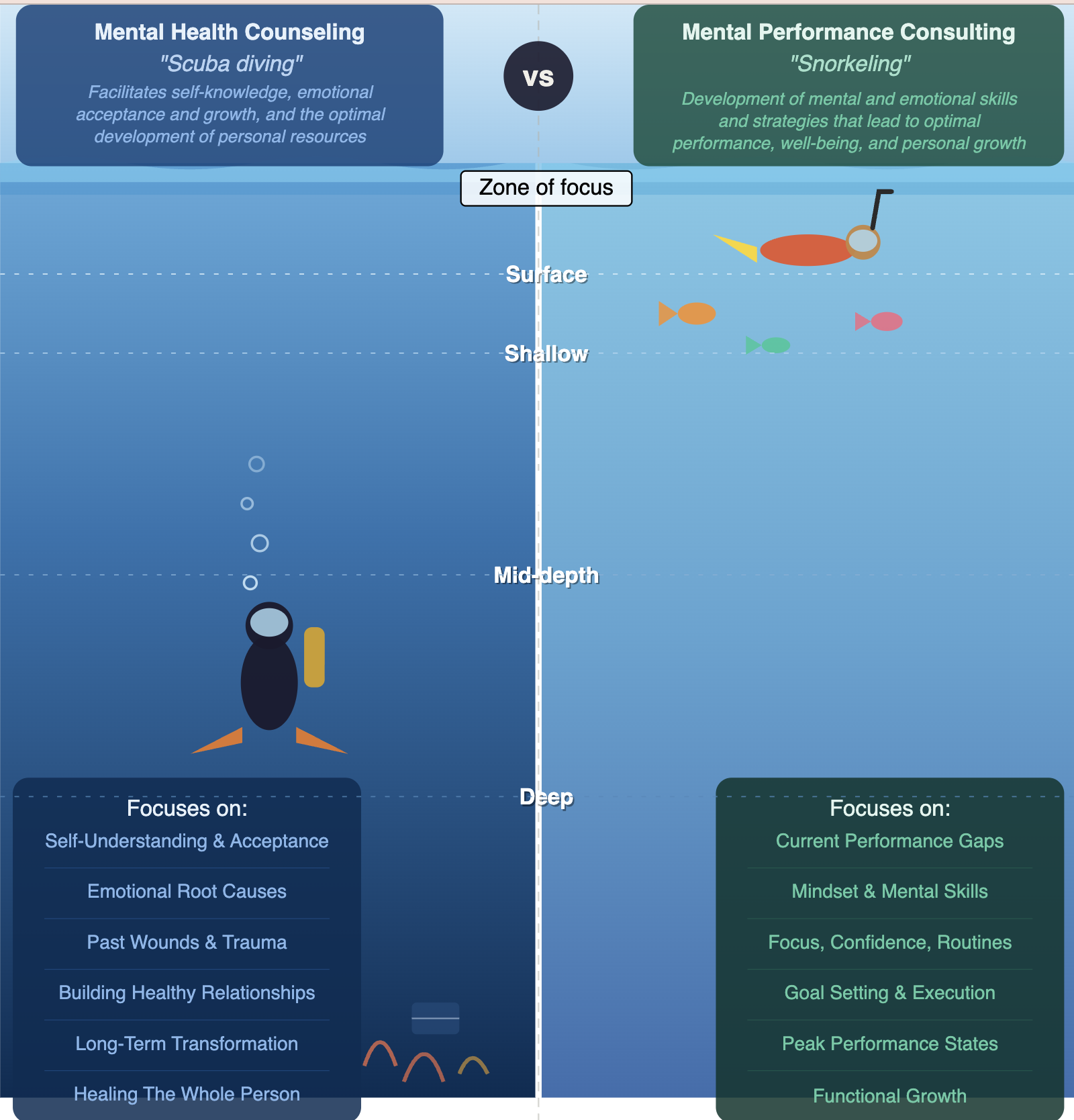
Counseling is defined as the skilled and principled use of a professional relationship to empower individuals to achieve mental health, wellness, education, and career goals (Kaplan, Tarvydas, & Gladding, 2014). It aims to facilitate self-knowledge, emotional acceptance and growth, and the optimal development of personal resources (Corey, 2017; Ivey, Ivey, & Zalaquett, 2018; Ryan, Lynch, Vansteenkiste, & Deci, 2011).
Additionally, in order to be able to provide counseling services, the professional must hold an accredited graduate degree (Master's or Doctoral) in counseling or a related field, complete thousands of hours of supervised clinical experience, pass state and national licensure examinations, and hold an active license in the state they reside.
On the other hand, consulting, in the sports context,refers to a collaborative process in which psychological, counseling, and athletic performance principles are applied with individuals, teams, and organizations to help them move from their current state to their desired state. The overall aim of consulting is to facilitate the development of mental and emotional skills, attitudes, perspectives, strategies, and processes that lead to optimal performance, well-being, and personal growth (Association for Applied Sport Psychology, 2020; Canadian Sport Psychology Association, 2020).
In order to offer consulting services, most often, professionals pursue certification through the Association of Applied Sport Psychology as a Certified Mental Performance Consultant (CMPC). These professionals have completed specific graduate education and supervised training to acquire the necessary counseling, psychology, and sport and performance science competencies to serve various types of performers. However, being licensed clinically is not required. To learn more about a Mental Performance Consultant, please follow the link here.
One way to think about and differientiate these two ways of working is to compare mental performance consulting to snorkeling while comparing mental health counseling to scuba diving…
What is the true difference between these two services? How do I know which one I need?
These are important questions to consider and gain some clarity on. However, the answer to these questions may not be as crystal clear as we expect them to be.
Mental health and mental performance aren't separate things — they exist on a continuum. The Association of Applied Sport Psychology has created a helpful visual of this continuum that's worth exploring. Whether you're competing on the pitch, performing on stage, leading in the boardroom, or operating in high-stakes environments, your mental health and well-being are always part of the picture. Mental health doesn't sit outside of performance — it underlies it, shapes it, and drives it.
So what's the difference between mental health counseling and mental performance consulting? The distinction isn't about which techniques are used, it comes down to where you're starting from, what you're currently dealing with, and what you're working toward. In practice, the two often overlap, and a thorough initial conversation is the best way to understand what kind of support will serve you best. If you're unsure which direction is right for you, that's completely okay — please feel free to reach out and we can figure it out together.