

Mental Health Counseling
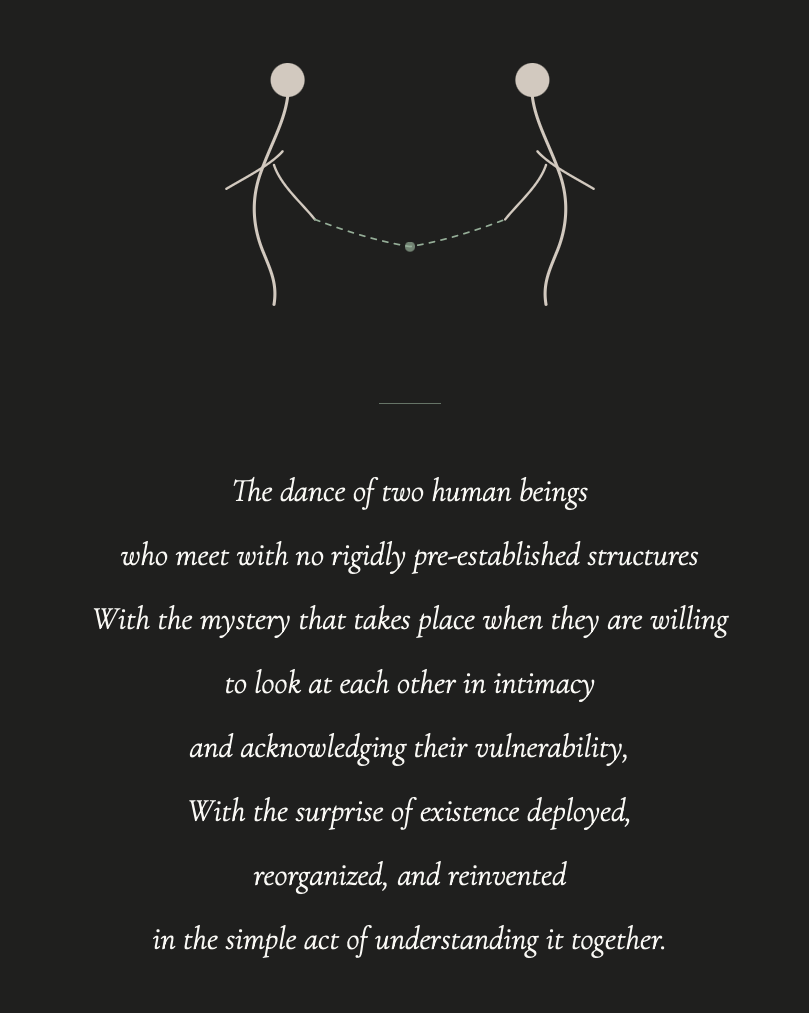
Navigating therapy can feel overwhelming before it even begins — finding the right therapist, understanding different approaches, or simply knowing what to expect from the process. It's a lot to take on, especially when you're already dealing with something hard. With this complexity in mind, I like to come back to the original meaning of the word therapy: to place ourselves alongside the other, to accompany with care wherever the other may be. That's what this space is meant to be. Not a clinical transaction or a process you have to figure out on your own — but someone walking alongside you, wherever you are. The work itself is rarely simple, but that purpose always is.
“Our central purpose is exploring, describing, clarifying - contstructing your experience moment to moment, together.”
My Approach:

The Framework
Existential-Integrative Therapy
My approach is best defined as existential-integrative therapy (EIT), which combines the core principles of existential psychology with various therapeutic techniques and theoretical perspectives to create a unique process specific to each client. This holistic approach considers the individual's physiological, psychological, emotional, social, and cultural factors, aiming for whole-person wellness. My approach is also supported by acceptance and commitment therapy (ACT) and somatic therapy, which focus on mindfulness, acceptance and behavior-change strategies, and the mind-body connection.
Existential-Integrative Therapy
Whole-Person Meaning & Existence
Acceptance & Commitment Therapy
Mindfulness & Psychological Flexibility
Somatic Therapy
Mind-Body Connection & Presence
How We Work
Experiential & Relational Focus
Central to my process is an experiential and relational focus, which seeks to foster a safe and intimate space where clients can directly engage with their self-protective patterns and underlying wounds, rather than just talking about them. In our therapeutic work together, I will focus on what unfolds in the present moment. I’ll pay close attention to how you relate both to yourself and to me, gently reflecting back aspects of your experience that may be evident but unnoticed.
I believe the meanings you've made from past experiences and life circumstances are carried into the present—some consciously, others less so—expressed through your body, voice, actions, values, and attitudes. Everything you express reveals something about your relationship with yourself, with others, and with the world. My intention is to attune closely to you and support you in becoming more present to your immediate experience, so you can more fully connect with what truly matters to you and, in doing so, bring new vitality to your life.
How Therapy Unfolds
While many people begin therapy during a time of crisis, it's often deeper, long-standing issues that truly bring them in. I aim to work efficiently, making each session count. Most clients aren’t expecting instant solutions, but they are typically experiencing real distress and looking for relief. As therapy continues, our focus often broadens—we move beyond just easing the pain to building something more fulfilling: stronger, more meaningful relationships, more creative and satisfying work, greater inner peace, and a deeper connection to life. Supporting others in reaching these goals is a key source of meaning in my own life.
A Practical, Individualized Approach
While my approach incorporates a level of depth in working, it is not always necessary. With my focus on tailoring therapy to the client’s unique needs, I also assist individuals in developing skills to meet their current demands which include emotional regulation, executive functioning, relationship building strategies, and general life skills. My intention is to make the therapy process pragmatic, which offers practical and applicable ways to engage in a more meaningful life.
Taking the First Step
The therapeutic journey can be a challenging one, and it is natural to be nervous about what you will explore, uncover, and learn about yourself. However, the more one can experience oneself in therapy, the more one can connect with what deeply matters; it is precisely this connection that leads towards a meaningful life.
Influences
My approach and philosophy within therapy has been fostered from and modeled after those that came before me, such as: Ernesto Spinelli, James F.T. Bugental, Kirk Schneider, Irvin Yalom, & Paul Wong.
Anxiety & Perfectionism
Depression, Burnout, & Grief
Self Esteem & Self-Worth
Self Discovery & Meaning
Relational Trauma
Young Adult Issues

Focus Areas:
Populations I Work With:

Adults Navigating Life
Former & Current Athletes
High Performing Professionals
Neurodiversity & LGBTQ+
Young Adults